A unit trains on the ground it can reach. Whatever terrain sits near its facility — that’s where the repetitions happen, day after day. The problem is that real operations rarely respect that geography. A team that has only ever rehearsed on familiar open ground may find itself working through dense urban space, or thick vegetation, or terrain that behaves nothing like the place it practised. And terrain isn’t a backdrop; it dictates movement, sightlines, communication, and tactics. Training for one environment and operating in another is a gap that real conditions expose quickly.
Why terrain is a training constraint
The constraint is purely physical. You can’t relocate a unit to every environment it might one day operate in, and you can’t reshape your training ground into a city one week and a jungle the next. Building physical mock-ups of different environments is expensive and limited, so most units end up over-rehearsed on the terrain they have and under-prepared for the terrain they don’t. The result is a kind of hidden specialisation — teams become fluent in their home ground and comparatively raw everywhere else.
This matters because adapting to unfamiliar terrain under pressure is itself a skill. The first time a team works through an environment radically different from its training ground, the unfamiliarity costs them — in speed, in coordination, in confidence — at exactly the moment they can least afford it.
What VR removes from the equation
Immersive training erases the geographic constraint. A VR environment can render any terrain on demand — dense urban blocks, open ground, complex multi-level structures, varied vegetation — and switch between them in moments. A unit can rehearse the same tactical problem across wildly different environments, learning directly how terrain reshapes their approach.
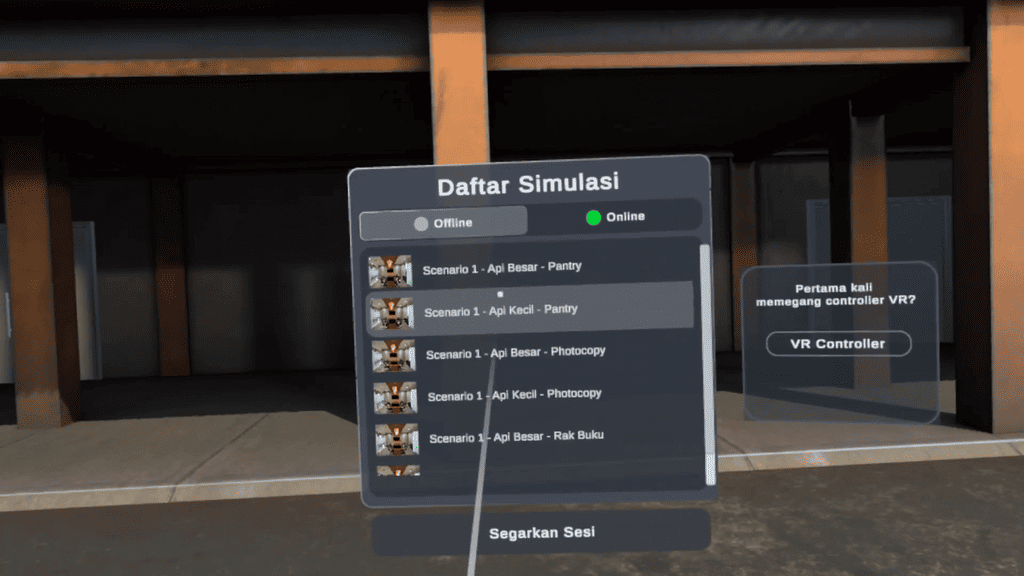
Indonesian developer KOMINA has built the tools this depends on — custom environment building and scenario design that let trainers construct terrain that mirrors the real ground a unit may face. Instead of being limited to the geography outside the door, a team can train for the geography of the mission. And because the environment can be varied endlessly, what’s really being built is adaptability — the ability to read any terrain and adjust, rather than fluency in just one.
Rehearsing the specific, not just the general
There’s a sharper application than general variety. When a unit knows the kind of environment it will operate in, a faithful reconstruction lets it rehearse that specific terrain in advance — the layout, the chokepoints, the way the ground channels movement. The team arrives already oriented, rather than learning the environment for the first time when it matters most. Familiarity with the ground is one of the oldest advantages in tactics, and VR makes it available for ground a unit could never physically visit beforehand.
The honest boundary
A simulation can’t reproduce everything terrain throws at a body — the actual footing, the fatigue of moving across difficult ground, the weather, the full physical reality. VR builds the spatial and tactical familiarity; it doesn’t replace the physical conditioning that real terrain demands. Both are needed.
But it dissolves the specific limit that has always constrained terrain training: you can only practise on the ground you can reach. By making any environment rehearsable, VR ensures a unit isn’t a stranger to the terrain the moment it matters.
The ground decides the fight as much as the people on it. A unit that only knows one kind of ground is half-prepared for the rest.